
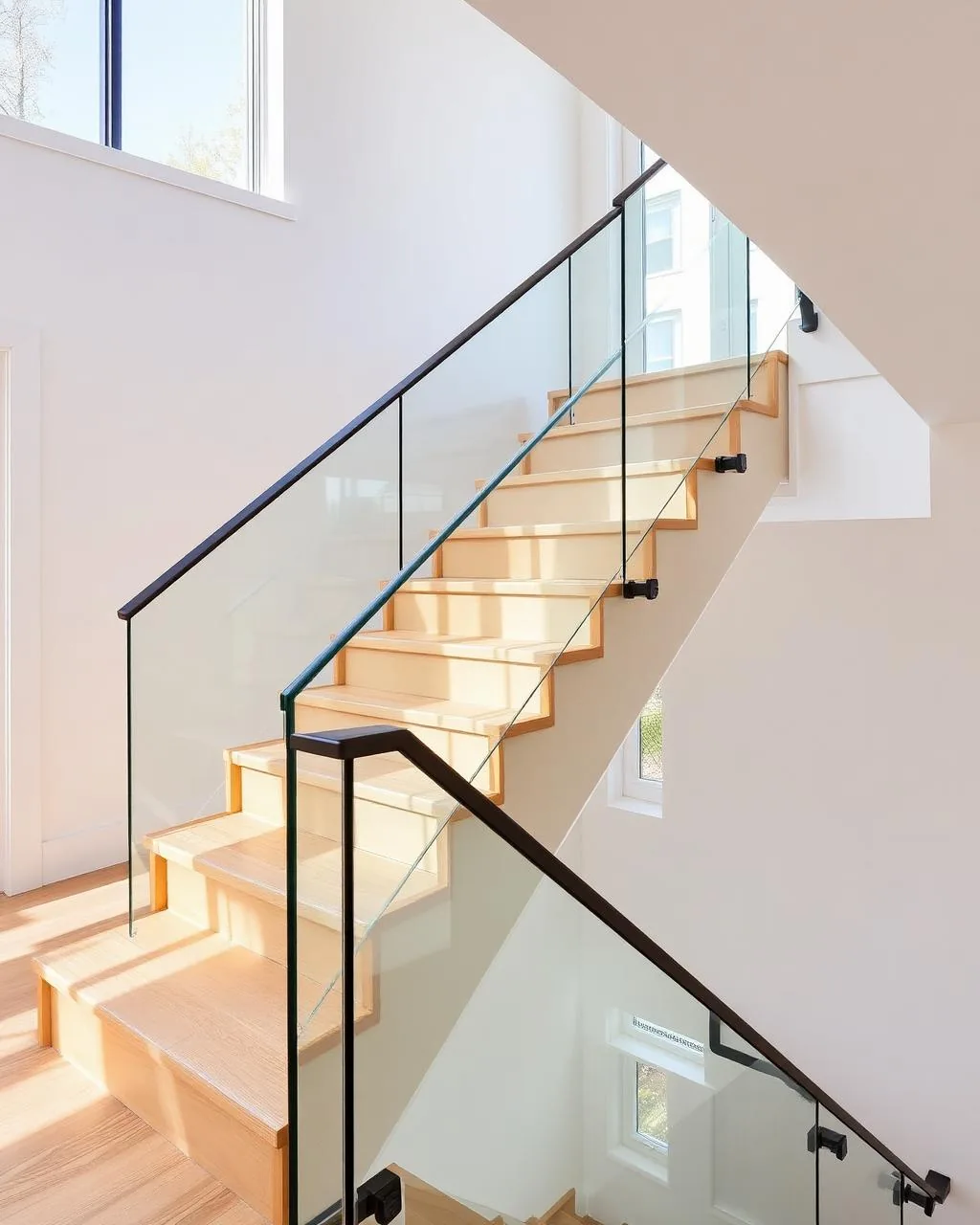
A glass railing is a structural safety guard, not a decorative feature. The Ontario Building Code (OBC) treats it that way, and so should you. Most homeowners we meet have never read the relevant OBC clauses — and they shouldn't have to. But knowing the basics is the difference between a railing that passes inspection now, passes inspection at resale, and protects your family for the next thirty years, versus one that has to be torn out and rebuilt the first time a buyer's home inspector flags it.
Here is the plain-English Glass Railing Experts breakdown of what the 2026 OBC actually requires, why the rules exist, and what to look for in a quote so you don't get sold a non-compliant system.
Where the OBC Applies
The OBC applies to every guard installed on a residential property in Ontario where there is a difference in elevation greater than 600 mm (about 24 inches). That covers exterior balconies, decks, terraces, rooftop patios, exterior stairs, interior stairs, mezzanines, and the open side of any landing. It does not technically apply to pool fencing — those are governed by municipal pool by-laws — but the OBC sphere rule and load requirements are still the practical baseline.
Glass Type: Tempered vs. Laminated Tempered
All glass installed in a guard must be safety glass. The OBC recognises two flavours: tempered, and laminated tempered. The difference matters.
Tempered Glass
Tempered glass is heat-treated so that, on impact, it fractures into thousands of small, relatively blunt pieces rather than long shards. It is roughly four times stronger than annealed glass and is the minimum spec for any framed glass railing where the aluminum or stainless frame carries the structural load.
Laminated Tempered Glass
Laminated tempered combines two tempered panels with a polyvinyl butyral (PVB) or SentryGlas interlayer. If a panel ever breaks, the interlayer holds the fragments together so the guard remains in service until the panel can be replaced. This is the OBC-required spec for any frameless system where the glass itself is the structural element — including base-shoe, standoff, and spigot systems. Don't accept a quote for a frameless railing that uses single-pane tempered. It is not code-compliant in 2026.
Guard Height Requirements
Heights are measured from the finished walking surface to the top of the guard.
Residential Balconies and Decks
If the walking surface is less than 1.8 m above grade, the minimum guard height is 900 mm (about 36 inches). If it is 1.8 m or more above grade, the minimum is 1070 mm (about 42 inches). Most second-storey balconies and rooftop terraces fall into the higher category by default.
Interior Stairs and Landings
Interior guards along open stair sides and landings must be at least 900 mm high, measured vertically from a line drawn through the nosings of the treads.
Pool Enclosures
Pool by-laws are municipal. Toronto and Burlington require 1.2 m. Mississauga, Vaughan, Markham, and Oakville require 1.5 m. Always confirm with your municipality before installation — Glass Railing Experts checks this for every pool fencing quote.
Load Requirements
The structural test is what most homeowners never see, but it's why engineering drawings exist. Every guard must resist a horizontal load of 0.75 kN per linear metre applied at the top of the guard, plus a concentrated load of 1.0 kN applied at any single point. For frameless systems, the base shoe or spigot specification, the glass thickness, and the panel width all interact to satisfy these loads. This is why a P.Eng. stamp on the shop drawings matters — it certifies the entire assembly meets the load requirements for your specific layout, not a generic catalogue install.
The 100 mm Sphere Rule
No opening in a guard may allow the passage of a 100 mm sphere. For solid glass panels, this is rarely an issue, but it does affect three details installers cut corners on: the gap between adjacent panels, the gap between the bottom of the glass and the finished floor, and any gap between the glass and an adjacent wall or column. Tight tolerances are not optional.
Climbability
On any guard protecting a fall greater than 1.8 m, no member or attachment between 140 mm and 900 mm above the walking surface may facilitate climbing. Glass panels naturally satisfy this rule, but ornate spigot bases, decorative caps, or horizontal cross-rails can quietly violate it. If you see a quote with a horizontal mid-rail on a frameless system, ask the installer to point to the OBC clause that allows it.
What to Look For in a Quote
A code-compliant quote will list the glass spec by thickness and lamination, the guard height in millimetres, the hardware spec by manufacturer and model, and either include or commit to providing P.Eng.-stamped shop drawings. If those four items are missing or vague, the installer is either inexperienced or knowingly cutting corners.
Why It Matters at Resale
A non-compliant glass railing fails home inspection. We see it every spring — homeowners who saved $1,500 on the install paying $6,000 to retrofit before their closing date. Every Glass Railing Experts installation across Toronto, North York, and the broader GTA ships with stamped engineered drawings and an OBC-compliance letter, so the railing passes inspection now and at every future sale.
Free Code-Compliant Quote Across the GTA
If you want a glass railing that meets the 2026 OBC without surprises, call Glass Railing Experts at 647-474-4751 for a free GTA quote. We engineer, fabricate, and install across all 20 cities in the Greater Toronto Area — every install backed by stamped drawings and a written workmanship warranty.
Ready to start your project?
Get a free, fixed-price quote across the GTA.